
Introduction
Coding agents edit source files as text. A frontier model mostly gets away with it. A small local model does not. It guesses an identifier that does not exist, writes a diff that does not apply or renames in one file and forgets the other twelve. The error shows up after the bytes are on disk, when a build breaks, and the agent is already three edits downstream. The weaker the model, the more of its budget goes to this.
The usual fix is a stricter text format or a bigger model. We take the opposite position. Keep the small model and change what it’s allowed to do. ago is a semantic edit protocol for Go. The agent does not write files. It queries a typechecked workspace and submits mutations from a versioned operation catalog. The compiler checks every mutation against an in-memory snapshot before anything is written. An edit that does not typecheck is not caught after the fact. It doesn’t reach disk.
The catalog is not novel or what guides the models to a solution. The interaction where the protocol informs the agent’s next step is. Every rejection is a turn in a conversation. It names what is wrong in typed compiler terms, and it hands back the corrected call, ready to resend. A weak model does not have to know the fix. It has to be handed the fix and copy it. That is a much lower bar, and it is the bar most small models can clear.
We test this against the honest alternatives. The same model, prompts and time budget run in three modes. Raw file editing. LSP symbol addressing with advisory validation (Serena (Oraios AI 2025)). The protocol. An oracle replays each task’s real answer through the protocol first, so no task enters the benchmark unless it is known to be solvable. Across three locally served models the same ranking appears in every model. The protocol leads symbol addressing, which leads raw editing. The gap is widest for the model that edits text worst. It passes almost nothing raw and recovers to a majority through the protocol. The reason is visible mid-edit. In the text modes the workspace spends much of the editing window failing to compile. In the protocol it almost never does.
Our contributions:
A semantic, transactional edit protocol for Go where an invalid edit is unrepresentable, not merely flagged.
The rejection-as-repair interaction and evidence that it is what lets weak models recover.
An oracle that certifies a task is solvable before any model spends time on it.
A three-mode benchmark across three local models, with every transcript, diff and score released.
The ago Protocol
Surface
Ten tools carry a versioned catalog of 33 operations. They span declaration, statement, test and project families. Seven query kinds return deterministic, paged responses. Node handles address statements inside declarations. Generation counters make staleness explicit instead of silent.
Transactions
An ordered op list validates as one unit against an in-memory snapshot. Ops apply to a copy. The dirty set re-typechecks once, in parallel, scheduled over post-edit import edges. Resolution proofs run, so a rename that would capture a reference is rejected even though the compiler would accept it. Then all files write together, or nothing does. Pre-existing issues in the affected packages are baselined and tolerated. Real codebases carry history, so only new diagnostics reject.
Rejection as conversation
Every rejection answers one question. What is the correct next call? It carries typed diagnostics, candidate lists and possible_repairs, complete calls the agent resends verbatim. Repairs are tested by execution before they are offered. A repair that would itself reject is worse than none. Resending a rejected call unchanged escalates. Accepted mutations embed the fresh view of the touched declaration, so back-to-back edits skip the read round trip.
Oracle Methodology
Every benchmark task comes from a real commit, so the correct answer is already known. Before any model attempts a task, the oracle submits that known answer through the protocol itself. If the right answer cannot get through, the model never had a chance. The problem is then ours, whether an engine bug, an extractor error or a named protocol ceiling. The task stays out of the roster until it is fixed. This separates “the model failed” from “the task was impossible” by construction. The oracle transcripts are a byproduct, a record of correct protocol usage for every task.
Benchmark
Same model, same harness, same prompts, same time cap, three modes. Token parity across prompts is enforced by test. Raw edits files with shell tools. Serena addresses symbols through the language server, a pinned revision of the Serena MCP server, but its validation stays advisory. Diagnostics are available on request, and nothing blocks a broken write from landing. Semantic sees only the protocol. The middle mode is the ablation that separates the two variables the protocol bundles, symbol addressing and mandatory validation. Scoring is a goal predicate, a clean typecheck and scoped tests. The test gate is voided where a pristine worktree also fails it. Serving is pinned per run. GLM-4.7-Flash (MoE) runs at UD-Q4_K_XL, roughly 20 GiB, with a q8_0 K/V cache at 128k context. gpt-oss-20b runs at MXFP4, 11.28 GiB of weights before KV. Qwen3.5-9B runs at UD-Q4_K_XL. Serving ran on two locally hosted GPUs, a 32 GB AMD Radeon AI Pro R9700 and an 8 GB NVIDIA RTX 3070 Ti, with the harness and typechecking on a separate Apple M5 Max workstation. Per-run hardware and serving configurations are in the released evidence. Local serving is part of the experiment, constraints included. Every episode records its transcript, diff, score, token usage, failure kind and the daemon’s request log. The evidence is the contribution as much as the numbers.
Evaluation freeze
Every run before the freeze tag is development data. Rejections became repairs, and oracle failures became engine fixes. That loop is a contribution, but it cannot also be the headline evidence. The engine is frozen at a tagged revision (eval-freeze-1). Every episode records the engine revision it ran under, so the split is auditable. Headline tables come only from frozen-tag runs over the development set of 20 oracle-certified tasks. A held-out set mined from etcd, caddy and hugo is extracted and certified only after the tag, with the frozen engine. A certification failure there is reported as a protocol ceiling, not fixed.
Invalid intermediate states
The mechanism claim is that validation before disk changes what a repository passes through, not just where an episode ends. A watcher samples each worktree during the agent’s editing window. When the mtime fingerprint of the Go files changes and then holds still for one interval, the settled state gets a go build ./... verdict. The oracle runs as the control and measures the sampler itself. Raw and advisory modes pass through whatever the model writes. The semantic mode cannot land a declaration that does not typecheck, so its measured rate is the write window itself. A mutation touching dozens of call sites writes files sequentially, and a sample can catch the half-written state. Replaying every accepted mutation from the flagged episodes shows each settled state compiles. No host tool wrote Go in any of them.
Results
Pooled over the frozen grid, semantic passed 150/300 episodes. Raw passed 70/300. The full per-task table (Appendix 10) tells the sharper story. Raw does best on the edits a find-and-replace would nearly cover. It drops toward zero on the tasks that need consistency across files.
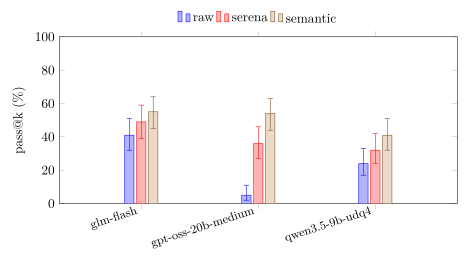
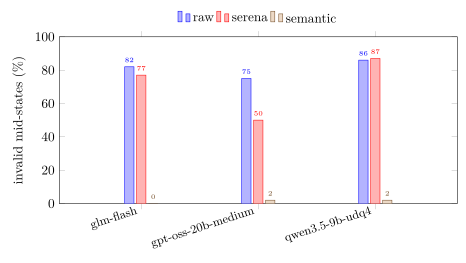
go build during the editing window. The text-editing modes churn through broken states. The semantic mode cannot land a declaration that does not typecheck, so its residual is only the multi-file write window. Generated from the same evidence.Two readings stand out. First, the mode ordering (Figure 1) comes out the same in all three models, semantic over serena over raw, though at k=5 the per-model intervals overlap and the ranking rests on the repetition across models and tasks, not on any one cell. Symbol addressing helps, and mandatory validation helps again on top of it. Second, the protocol’s advantage is not uniform. It is widest for the model that edits text worst. A strong instruction-follower that is nonetheless a poor freeform tool user passes almost nothing raw, yet recovers to a majority through the protocol. The protocol removes exactly the failure it is prone to. The invalid-intermediate rate (Figure 2) is the mechanism. Both text modes leave the workspace uncompilable for half to most of the editing window, while the semantic mode holds it valid nearly throughout.
Limitations
One language. The protocol is built on Go’s type and package model, and every result here is Go. Whether it helps in a language with a weaker or slower static checker is untested.
Contamination. The tasks are mined from public repositories the models have likely trained on. This inflates the absolute pass rates. It is held equal across all three modes, so the comparison between them is fair. The claim is the ordering, not the raw percentages.
Small k. Each cell is five episodes, so the per-task confidence intervals are wide. The result rests on the direction repeating across twenty tasks and three models, not on any single cell. One quant fixes each model to a single serving stack. A different quantization or server could move the numbers.
Narrow task shape. The development set is twenty tasks over a few edit kinds, rename, add-parameter and move. These all transform code that already exists in a known-correct form. Authoring new code is a different regime. The protocol can still reject an edit that does not typecheck, but the repair channel has no ground-truth declaration to hand back, so whether the advantage holds is untested. The held-out set from etcd, caddy and hugo widens the task pool, but it does not cross into authoring. That gap is open.
One baseline per alternative. Raw uses shell tools. Serena is one symbol-addressing implementation at a pinned revision. A different text harness or a different LSP server could close or widen the gap.
Uncontrolled conditions. The runs were not executed in a controlled environment. The hardware is a self-hosted home lab, prosumer and consumer parts, shared with other load, under thermal and power conditions that varied across a run. Rounds were paused and resumed rather than run start to finish, so a single round spans hours or days of wall clock and whatever the machine was doing in between. Completed episodes are never re-run on resume, so the pass counts and invalid-intermediate counts are unaffected. The timing figures are not. Median time-to-green, the wall-clock seconds to a passing state, and the cap sit on top of variable generation speed, and an episode that throttles near the cap can hit it for a reason that is thermal, not model. This bites only the episodes already close to the limit, but where a model caps often it is a real source of noise. Treat the outcome columns as the result and the timing columns as soft.
Author-run. The serving, harness and scoring are all ours. Every transcript, diff, request log and serving configuration is released so the result can be checked, but it has not been reproduced independently yet.
Conclusion
ago shows that the manner in which a weak model edits code can matter as much as the size of the model. Replace text editing with validated, transactional mutations. Make every rejection carry its own fix. A 9B model then passes 41% of repository-scale edits through the protocol against 24% raw, beside the 30B-class incumbent’s 41% with raw text editing. The effect is largest exactly where it should be, on the model that is worst at freeform editing, which climbs from 5% to 54%.
The mechanism is direct. Validation happens before the write, so a broken state is never on disk for the next step to trip over. The repair channel turns a rejection into a paste. The model spends its budget on the task instead of on recovering from its own malformed edits. The invalid-intermediate rate makes this concrete. The text modes leave the workspace uncompilable 75% to 86% of the time mid-edit. The protocol holds at 2% or below.
The scope is narrow and stated. One language. One serving stack per model. Small k, and the infrastructure is author-run. Contamination is held equal across modes but still inflates the absolute rates. The ordering is the claim, and it repeated in every model and task set we ran, but these caveats cap how far the absolute numbers travel.
Two things come next. The held-out set from etcd, caddy and hugo tests the frozen engine on tasks it was never tuned against. A failure there is a protocol ceiling we report, not a bug we patch. And the oracle transcripts record correct protocol usage for every task, a natural seed for training a model to use it. The protocol that measures a weak model could also help make one less weak.
Availability
Code (MIT), all episode evidence and analysis tooling are at https://github.com/guygrigsby/agent-go.
Per-task results
Per-task, per-mode outcomes across the frozen grid. Generated from committed episode evidence. Each pass@k is over k episodes. Median time-to-green is over passing episodes.
| profile | task | mode | pass@k | median green (s) | capped | resends |
|---|---|---|---|---|---|---|
| glm-flash | boundary_06d69f69 | raw | 5/5 | 232 | 0 | 0 |
| glm-flash | boundary_06d69f69 | semantic | 5/5 | 251 | 0 | 2 |
| glm-flash | boundary_06d69f69 | serena | 5/5 | 175 | 0 | 0 |
| glm-flash | boundary_35b91c66 | raw | 2/5 | 544 | 3 | 0 |
| glm-flash | boundary_35b91c66 | semantic | 2/5 | 522 | 3 | 12 |
| glm-flash | boundary_35b91c66 | serena | 4/5 | 254 | 0 | 0 |
| glm-flash | boundary_57ffc718 | raw | 0/5 | – | 5 | 0 |
| glm-flash | boundary_57ffc718 | semantic | 2/5 | 469 | 3 | 20 |
| glm-flash | boundary_57ffc718 | serena | 0/5 | – | 5 | 0 |
| glm-flash | boundary_687dd1bd | raw | 0/5 | – | 3 | 0 |
| glm-flash | boundary_687dd1bd | semantic | 0/5 | – | 5 | 72 |
| glm-flash | boundary_687dd1bd | serena | 0/5 | – | 4 | 0 |
| glm-flash | boundary_9237d6f7 | raw | 1/5 | 554 | 1 | 0 |
| glm-flash | boundary_9237d6f7 | semantic | 2/5 | 378 | 1 | 92 |
| glm-flash | boundary_9237d6f7 | serena | 4/5 | 198 | 0 | 0 |
| glm-flash | boundary_9354a4eb | raw | 0/5 | – | 5 | 0 |
| glm-flash | boundary_9354a4eb | semantic | 0/5 | – | 5 | 6 |
| glm-flash | boundary_9354a4eb | serena | 0/5 | – | 5 | 0 |
| glm-flash | boundary_9f2c83f3 | raw | 2/5 | 671 | 4 | 0 |
| glm-flash | boundary_9f2c83f3 | semantic | 4/5 | 354 | 0 | 6 |
| glm-flash | boundary_9f2c83f3 | serena | 3/5 | 675 | 0 | 0 |
| glm-flash | boundary_b26814a3 | raw | 1/5 | 720 | 4 | 0 |
| glm-flash | boundary_b26814a3 | semantic | 3/5 | 720 | 4 | 25 |
| glm-flash | boundary_b26814a3 | serena | 5/5 | 390 | 0 | 0 |
| glm-flash | boundary_b4b95e0f | raw | 0/5 | – | 5 | 0 |
| glm-flash | boundary_b4b95e0f | semantic | 0/5 | – | 5 | 4 |
| glm-flash | boundary_b4b95e0f | serena | 0/5 | – | 5 | 0 |
| glm-flash | boundary_bf1486f7 | raw | 0/5 | – | 5 | 0 |
| glm-flash | boundary_bf1486f7 | semantic | 4/5 | 657 | 3 | 6 |
| glm-flash | boundary_bf1486f7 | serena | 0/5 | – | 5 | 0 |
| glm-flash | boundary_c0532428 | raw | 5/5 | 449 | 1 | 0 |
| glm-flash | boundary_c0532428 | semantic | 5/5 | 296 | 0 | 3 |
| glm-flash | boundary_c0532428 | serena | 5/5 | 156 | 0 | 0 |
| glm-flash | boundary_caf19f86 | raw | 5/5 | 711 | 2 | 0 |
| glm-flash | boundary_caf19f86 | semantic | 5/5 | 336 | 0 | 3 |
| glm-flash | boundary_caf19f86 | serena | 5/5 | 190 | 0 | 0 |
| glm-flash | boundary_dd2c3807 | raw | 1/5 | 900 | 2 | 0 |
| glm-flash | boundary_dd2c3807 | semantic | 2/5 | 720 | 5 | 19 |
| glm-flash | boundary_dd2c3807 | serena | 1/5 | 741 | 3 | 0 |
| glm-flash | boundary_eb61ac63 | raw | 0/5 | – | 5 | 0 |
| glm-flash | boundary_eb61ac63 | semantic | 3/5 | 720 | 5 | 20 |
| glm-flash | boundary_eb61ac63 | serena | 0/5 | – | 5 | 0 |
| glm-flash | boundary_fb1ea92a | raw | 5/5 | 444 | 0 | 0 |
| glm-flash | boundary_fb1ea92a | semantic | 0/5 | – | 5 | 76 |
| glm-flash | boundary_fb1ea92a | serena | 1/5 | 308 | 2 | 0 |
| glm-flash | traefik_51491463 | raw | 4/5 | 259 | 0 | 0 |
| glm-flash | traefik_51491463 | semantic | 5/5 | 277 | 0 | 2 |
| glm-flash | traefik_51491463 | serena | 4/5 | 138 | 0 | 0 |
| glm-flash | vault_7103bc2c | raw | 0/5 | – | 2 | 0 |
| glm-flash | vault_7103bc2c | semantic | 0/5 | – | 5 | 12 |
| glm-flash | vault_7103bc2c | serena | 0/5 | – | 4 | 0 |
| glm-flash | vault_95b24f55 | raw | 5/5 | 325 | 0 | 0 |
| glm-flash | vault_95b24f55 | semantic | 5/5 | 367 | 0 | 4 |
| glm-flash | vault_95b24f55 | serena | 5/5 | 235 | 0 | 0 |
| glm-flash | vault_caec65a7 | raw | 0/5 | – | 5 | 0 |
| glm-flash | vault_caec65a7 | semantic | 5/5 | 422 | 0 | 0 |
| glm-flash | vault_caec65a7 | serena | 4/5 | 588 | 2 | 0 |
| glm-flash | vault_cfff8d42 | raw | 5/5 | 349 | 0 | 0 |
| glm-flash | vault_cfff8d42 | semantic | 3/5 | 720 | 5 | 24 |
| glm-flash | vault_cfff8d42 | serena | 3/5 | 290 | 3 | 0 |
| gpt-oss-20b-medium | boundary_06d69f69 | raw | 0/5 | – | 0 | 0 |
| gpt-oss-20b-medium | boundary_06d69f69 | semantic | 5/5 | 157 | 0 | 1 |
| gpt-oss-20b-medium | boundary_06d69f69 | serena | 5/5 | 143 | 0 | 0 |
| gpt-oss-20b-medium | boundary_35b91c66 | raw | 0/5 | – | 0 | 0 |
| gpt-oss-20b-medium | boundary_35b91c66 | semantic | 5/5 | 274 | 0 | 2 |
| gpt-oss-20b-medium | boundary_35b91c66 | serena | 5/5 | 124 | 0 | 0 |
| gpt-oss-20b-medium | boundary_57ffc718 | raw | 0/5 | – | 0 | 0 |
| gpt-oss-20b-medium | boundary_57ffc718 | semantic | 0/5 | – | 0 | 6 |
| gpt-oss-20b-medium | boundary_57ffc718 | serena | 0/5 | – | 0 | 0 |
| gpt-oss-20b-medium | boundary_687dd1bd | raw | 0/5 | – | 0 | 0 |
| gpt-oss-20b-medium | boundary_687dd1bd | semantic | 0/5 | – | 0 | 6 |
| gpt-oss-20b-medium | boundary_687dd1bd | serena | 0/5 | – | 0 | 0 |
| gpt-oss-20b-medium | boundary_9237d6f7 | raw | 0/5 | – | 0 | 0 |
| gpt-oss-20b-medium | boundary_9237d6f7 | semantic | 4/5 | 331 | 0 | 6 |
| gpt-oss-20b-medium | boundary_9237d6f7 | serena | 4/5 | 87 | 0 | 0 |
| gpt-oss-20b-medium | boundary_9354a4eb | raw | 0/5 | – | 0 | 0 |
| gpt-oss-20b-medium | boundary_9354a4eb | semantic | 0/5 | – | 0 | 5 |
| gpt-oss-20b-medium | boundary_9354a4eb | serena | 0/5 | – | 0 | 0 |
| gpt-oss-20b-medium | boundary_9f2c83f3 | raw | 0/5 | – | 0 | 0 |
| gpt-oss-20b-medium | boundary_9f2c83f3 | semantic | 4/5 | 275 | 0 | 2 |
| gpt-oss-20b-medium | boundary_9f2c83f3 | serena | 2/5 | 135 | 0 | 0 |
| gpt-oss-20b-medium | boundary_b26814a3 | raw | 0/5 | – | 0 | 0 |
| gpt-oss-20b-medium | boundary_b26814a3 | semantic | 0/5 | – | 0 | 5 |
| gpt-oss-20b-medium | boundary_b26814a3 | serena | 0/5 | – | 0 | 0 |
| gpt-oss-20b-medium | boundary_b4b95e0f | raw | 0/5 | – | 0 | 0 |
| gpt-oss-20b-medium | boundary_b4b95e0f | semantic | 0/5 | – | 0 | 6 |
| gpt-oss-20b-medium | boundary_b4b95e0f | serena | 0/5 | – | 0 | 0 |
| gpt-oss-20b-medium | boundary_bf1486f7 | raw | 0/5 | – | 0 | 0 |
| gpt-oss-20b-medium | boundary_bf1486f7 | semantic | 3/5 | 160 | 0 | 10 |
| gpt-oss-20b-medium | boundary_bf1486f7 | serena | 0/5 | – | 0 | 0 |
| gpt-oss-20b-medium | boundary_c0532428 | raw | 1/5 | 124 | 0 | 0 |
| gpt-oss-20b-medium | boundary_c0532428 | semantic | 5/5 | 123 | 0 | 5 |
| gpt-oss-20b-medium | boundary_c0532428 | serena | 2/5 | 141 | 0 | 0 |
| gpt-oss-20b-medium | boundary_caf19f86 | raw | 0/5 | – | 0 | 0 |
| gpt-oss-20b-medium | boundary_caf19f86 | semantic | 5/5 | 229 | 0 | 0 |
| gpt-oss-20b-medium | boundary_caf19f86 | serena | 5/5 | 98 | 0 | 0 |
| gpt-oss-20b-medium | boundary_dd2c3807 | raw | 0/5 | – | 0 | 0 |
| gpt-oss-20b-medium | boundary_dd2c3807 | semantic | 0/5 | – | 0 | 11 |
| gpt-oss-20b-medium | boundary_dd2c3807 | serena | 0/5 | – | 0 | 0 |
| gpt-oss-20b-medium | boundary_eb61ac63 | raw | 0/5 | – | 0 | 0 |
| gpt-oss-20b-medium | boundary_eb61ac63 | semantic | 3/5 | 133 | 0 | 0 |
| gpt-oss-20b-medium | boundary_eb61ac63 | serena | 0/5 | – | 0 | 0 |
| gpt-oss-20b-medium | boundary_fb1ea92a | raw | 0/5 | – | 0 | 0 |
| gpt-oss-20b-medium | boundary_fb1ea92a | semantic | 0/5 | – | 0 | 17 |
| gpt-oss-20b-medium | boundary_fb1ea92a | serena | 0/5 | – | 0 | 0 |
| gpt-oss-20b-medium | traefik_51491463 | raw | 0/5 | – | 0 | 0 |
| gpt-oss-20b-medium | traefik_51491463 | semantic | 5/5 | 176 | 0 | 8 |
| gpt-oss-20b-medium | traefik_51491463 | serena | 1/5 | 102 | 0 | 0 |
| gpt-oss-20b-medium | vault_7103bc2c | raw | 0/5 | – | 0 | 0 |
| gpt-oss-20b-medium | vault_7103bc2c | semantic | 0/5 | – | 0 | 5 |
| gpt-oss-20b-medium | vault_7103bc2c | serena | 0/5 | – | 0 | 0 |
| gpt-oss-20b-medium | vault_95b24f55 | raw | 0/5 | – | 0 | 0 |
| gpt-oss-20b-medium | vault_95b24f55 | semantic | 5/5 | 292 | 0 | 1 |
| gpt-oss-20b-medium | vault_95b24f55 | serena | 5/5 | 174 | 0 | 0 |
| gpt-oss-20b-medium | vault_caec65a7 | raw | 1/5 | 159 | 0 | 0 |
| gpt-oss-20b-medium | vault_caec65a7 | semantic | 5/5 | 275 | 0 | 0 |
| gpt-oss-20b-medium | vault_caec65a7 | serena | 3/5 | 250 | 0 | 0 |
| gpt-oss-20b-medium | vault_cfff8d42 | raw | 3/5 | 116 | 0 | 0 |
| gpt-oss-20b-medium | vault_cfff8d42 | semantic | 5/5 | 106 | 0 | 8 |
| gpt-oss-20b-medium | vault_cfff8d42 | serena | 4/5 | 202 | 0 | 0 |
| qwen3.5-9b-udq4 | boundary_06d69f69 | raw | 5/5 | 61 | 0 | 0 |
| qwen3.5-9b-udq4 | boundary_06d69f69 | semantic | 5/5 | 169 | 0 | 0 |
| qwen3.5-9b-udq4 | boundary_06d69f69 | serena | 5/5 | 92 | 0 | 0 |
| qwen3.5-9b-udq4 | boundary_35b91c66 | raw | 0/5 | – | 0 | 0 |
| qwen3.5-9b-udq4 | boundary_35b91c66 | semantic | 3/5 | 275 | 0 | 2 |
| qwen3.5-9b-udq4 | boundary_35b91c66 | serena | 3/5 | 142 | 0 | 0 |
| qwen3.5-9b-udq4 | boundary_57ffc718 | raw | 0/5 | – | 0 | 0 |
| qwen3.5-9b-udq4 | boundary_57ffc718 | semantic | 1/5 | 204 | 0 | 3 |
| qwen3.5-9b-udq4 | boundary_57ffc718 | serena | 0/5 | – | 1 | 0 |
| qwen3.5-9b-udq4 | boundary_687dd1bd | raw | 1/5 | 217 | 0 | 0 |
| qwen3.5-9b-udq4 | boundary_687dd1bd | semantic | 0/5 | – | 0 | 2 |
| qwen3.5-9b-udq4 | boundary_687dd1bd | serena | 0/5 | – | 0 | 0 |
| qwen3.5-9b-udq4 | boundary_9237d6f7 | raw | 0/5 | – | 0 | 0 |
| qwen3.5-9b-udq4 | boundary_9237d6f7 | semantic | 1/5 | 676 | 0 | 2 |
| qwen3.5-9b-udq4 | boundary_9237d6f7 | serena | 3/5 | 66 | 0 | 0 |
| qwen3.5-9b-udq4 | boundary_9354a4eb | raw | 0/5 | – | 0 | 0 |
| qwen3.5-9b-udq4 | boundary_9354a4eb | semantic | 0/5 | – | 0 | 4 |
| qwen3.5-9b-udq4 | boundary_9354a4eb | serena | 0/5 | – | 0 | 0 |
| qwen3.5-9b-udq4 | boundary_9f2c83f3 | raw | 0/5 | – | 0 | 0 |
| qwen3.5-9b-udq4 | boundary_9f2c83f3 | semantic | 3/5 | 134 | 0 | 3 |
| qwen3.5-9b-udq4 | boundary_9f2c83f3 | serena | 3/5 | 136 | 1 | 0 |
| qwen3.5-9b-udq4 | boundary_b26814a3 | raw | 0/5 | – | 0 | 0 |
| qwen3.5-9b-udq4 | boundary_b26814a3 | semantic | 2/5 | 204 | 0 | 10 |
| qwen3.5-9b-udq4 | boundary_b26814a3 | serena | 0/5 | – | 1 | 0 |
| qwen3.5-9b-udq4 | boundary_b4b95e0f | raw | 0/5 | – | 1 | 0 |
| qwen3.5-9b-udq4 | boundary_b4b95e0f | semantic | 0/5 | – | 0 | 0 |
| qwen3.5-9b-udq4 | boundary_b4b95e0f | serena | 0/5 | – | 0 | 0 |
| qwen3.5-9b-udq4 | boundary_bf1486f7 | raw | 0/5 | – | 0 | 0 |
| qwen3.5-9b-udq4 | boundary_bf1486f7 | semantic | 1/5 | 122 | 0 | 1 |
| qwen3.5-9b-udq4 | boundary_bf1486f7 | serena | 0/5 | – | 0 | 0 |
| qwen3.5-9b-udq4 | boundary_c0532428 | raw | 5/5 | 132 | 0 | 0 |
| qwen3.5-9b-udq4 | boundary_c0532428 | semantic | 3/5 | 204 | 0 | 17 |
| qwen3.5-9b-udq4 | boundary_c0532428 | serena | 3/5 | 92 | 0 | 0 |
| qwen3.5-9b-udq4 | boundary_caf19f86 | raw | 3/5 | 328 | 0 | 0 |
| qwen3.5-9b-udq4 | boundary_caf19f86 | semantic | 1/5 | 50 | 0 | 5 |
| qwen3.5-9b-udq4 | boundary_caf19f86 | serena | 4/5 | 98 | 0 | 0 |
| qwen3.5-9b-udq4 | boundary_dd2c3807 | raw | 0/5 | – | 0 | 0 |
| qwen3.5-9b-udq4 | boundary_dd2c3807 | semantic | 3/5 | 166 | 0 | 49 |
| qwen3.5-9b-udq4 | boundary_dd2c3807 | serena | 0/5 | – | 0 | 0 |
| qwen3.5-9b-udq4 | boundary_eb61ac63 | raw | 0/5 | – | 0 | 0 |
| qwen3.5-9b-udq4 | boundary_eb61ac63 | semantic | 0/5 | – | 0 | 15 |
| qwen3.5-9b-udq4 | boundary_eb61ac63 | serena | 0/5 | – | 0 | 0 |
| qwen3.5-9b-udq4 | boundary_fb1ea92a | raw | 0/5 | – | 0 | 0 |
| qwen3.5-9b-udq4 | boundary_fb1ea92a | semantic | 0/5 | – | 0 | 4 |
| qwen3.5-9b-udq4 | boundary_fb1ea92a | serena | 0/5 | – | 1 | 0 |
| qwen3.5-9b-udq4 | traefik_51491463 | raw | 4/5 | 85 | 0 | 0 |
| qwen3.5-9b-udq4 | traefik_51491463 | semantic | 5/5 | 136 | 0 | 1 |
| qwen3.5-9b-udq4 | traefik_51491463 | serena | 3/5 | 111 | 0 | 0 |
| qwen3.5-9b-udq4 | vault_7103bc2c | raw | 0/5 | – | 0 | 0 |
| qwen3.5-9b-udq4 | vault_7103bc2c | semantic | 0/5 | – | 0 | 3 |
| qwen3.5-9b-udq4 | vault_7103bc2c | serena | 0/5 | – | 1 | 0 |
| qwen3.5-9b-udq4 | vault_95b24f55 | raw | 1/5 | 98 | 0 | 0 |
| qwen3.5-9b-udq4 | vault_95b24f55 | semantic | 5/5 | 274 | 0 | 0 |
| qwen3.5-9b-udq4 | vault_95b24f55 | serena | 4/5 | 228 | 0 | 0 |
| qwen3.5-9b-udq4 | vault_caec65a7 | raw | 0/5 | – | 1 | 0 |
| qwen3.5-9b-udq4 | vault_caec65a7 | semantic | 5/5 | 590 | 1 | 0 |
| qwen3.5-9b-udq4 | vault_caec65a7 | serena | 2/5 | 286 | 1 | 0 |
| qwen3.5-9b-udq4 | vault_cfff8d42 | raw | 5/5 | 60 | 0 | 0 |
| qwen3.5-9b-udq4 | vault_cfff8d42 | semantic | 3/5 | 291 | 1 | 10 |
| qwen3.5-9b-udq4 | vault_cfff8d42 | serena | 2/5 | 257 | 0 | 0 |